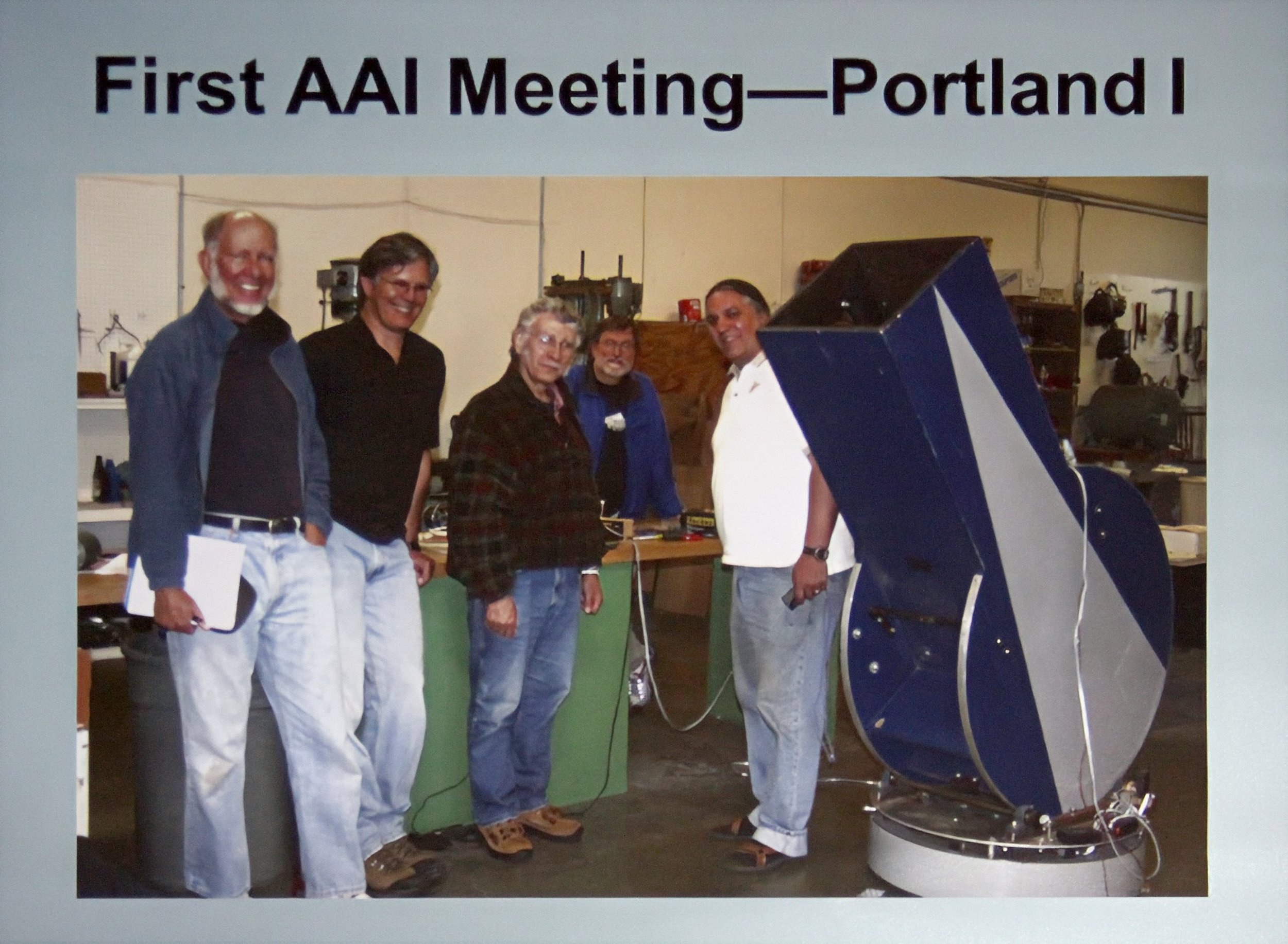
Russ Genet, Howard Banich, Richard Berry, Mel Bartels, Dan Gray, and the Lollipop.
First meeting of the Alt-Az Initiative, 2006
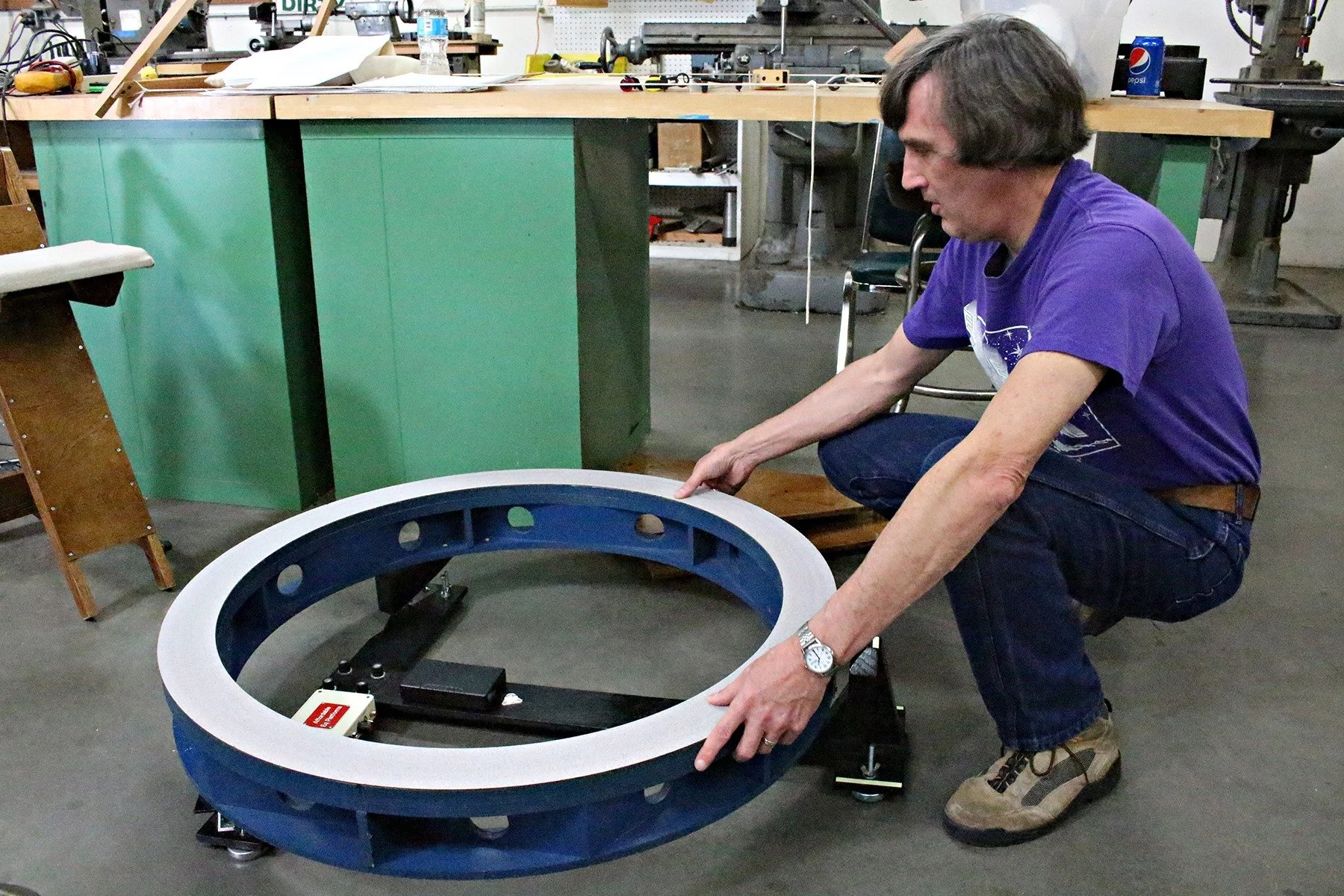
Jerry Oltion demonstrates a low-profile equatorial platform for his 20”
Russ Genet talked a few of us into founding the Altaz Initiative. Back then the idea was to explore ways to lower the cost of 1-2 meter scopes by 10x, maybe 100x. This to make small colleges competitive in attracting STEM students. The 1-2 meter size was chosen because that's was the smallest size to do meaningful spectroscopy. Nowadays, the minimum spectroscopic telescope size is smaller.
Before that, Russ had 'organized' the field of microcomputer control of telescopes. His book by that name was our bible for those of us working on early amateur computer control of telescopes. And Russ had gotten into 'robotic' telescopes, the forerunner of today's smartscopes.
Russ's genius is organizing people, connecting them to realize a larger goal beyond any individual.
At the same time, Oregon Scope Werks was founded by a handful of Oregon inventors who wanted a private space to hobnob, away from naysayers and noise on the existing forums and discussion groups. David Davis in particular experimented with all sorts of glass shapes.
The two groups have had a lose association since then. In fact, Russ and David are featured in the book, "A Bunch of American Amateurs: A Search for the American Character".
Even when ideas didn't turn out, which they often did, there was something to learn. In that sense, all that we did was a 'success'.
Before the Altaz Initiative, Richard Berry and a few of us organized the first in the world conferences on digital imaging, called, "Image the Sky". And the Bellingham Washington people organized the annual Optics Workshop that brought together pro and amateur mirror makers. Before that was the NWRAl meetings at Goldendale Obs where I saw the first Poncet platform telescope built in the country, by Ulver. And Del Wiseman (Portland) and Nick Liepins (Salem) experimented with cold cameras in the '60's. Their astrophotos and scopes were featured in Sky and Telescope.
Along with all of this was the arrival of John Dobson on the scene. His countless telescope making classes conducted over many years up and down the west cost seeded amateur astronomy here in the Pacific Northwest.
And the Oregon Star Party Telescope Walkabout became a 'destination' for those wanting to show their telescope innovations and makings.
I should also mention the impact of the Oregon Star Party and their relentless pursuit of the darkest skies possible.
And Howard Banich's observations and drawings. It's safe to say that he's equal to Herschel if not more. He's had a worldwide impact.
Jerry Oltion ran the telescope making column in S&T for a decade. Now it's Jonathan Kissner. All speakers for the conference.